
Introduction to Room Alignments in Ballroom Dance
In ballroom dancing, precision and orientation are just as important as rhythm and technique. One essential concept that helps dancers navigate the floor with accuracy is room alignment. Room alignments refer to the standardized directions dancers use to position and move themselves within a ballroom. Much like a compass provides direction for navigation, room alignments offer a spatial framework that helps both instructors and students understand where steps should begin, end, or transition.
Whether you're learning your first box step or refining a competition routine, understanding room alignments is key to executing patterns correctly, maintaining flow on the dance floor, and communicating effectively with your partner. Let’s explore what these alignments are and why they’re a fundamental part of every ballroom dancer’s skill set.
In ballroom dancing, room alignments can be compared to points on a compass to help dancers understand direction and orientation within the ballroom. Just like a compass uses North, South, East, and West to indicate direction, ballroom dancing uses a set of standardized reference points in the room to define where movements begin and end. Here's how room alignments translate to compass-like directions:
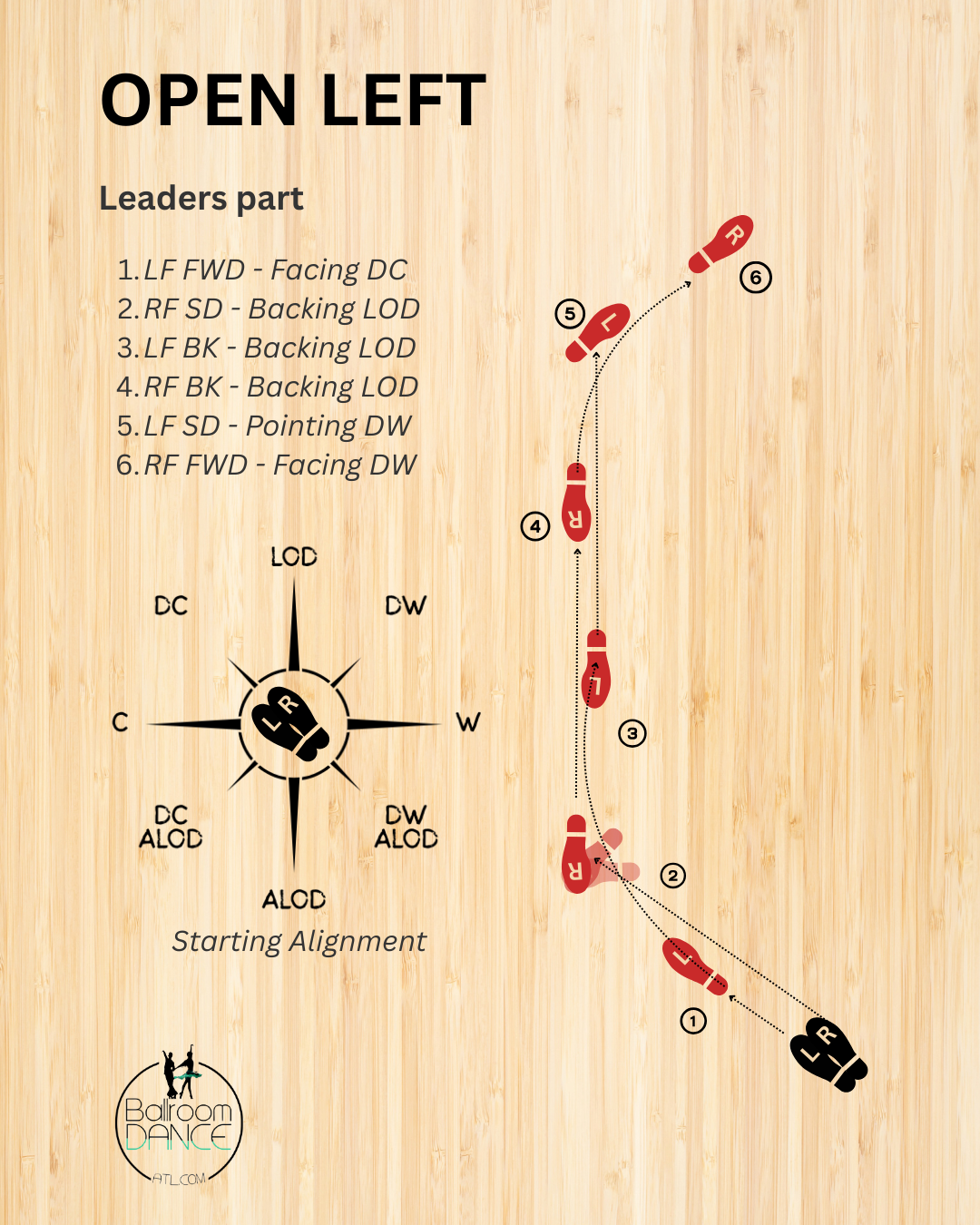
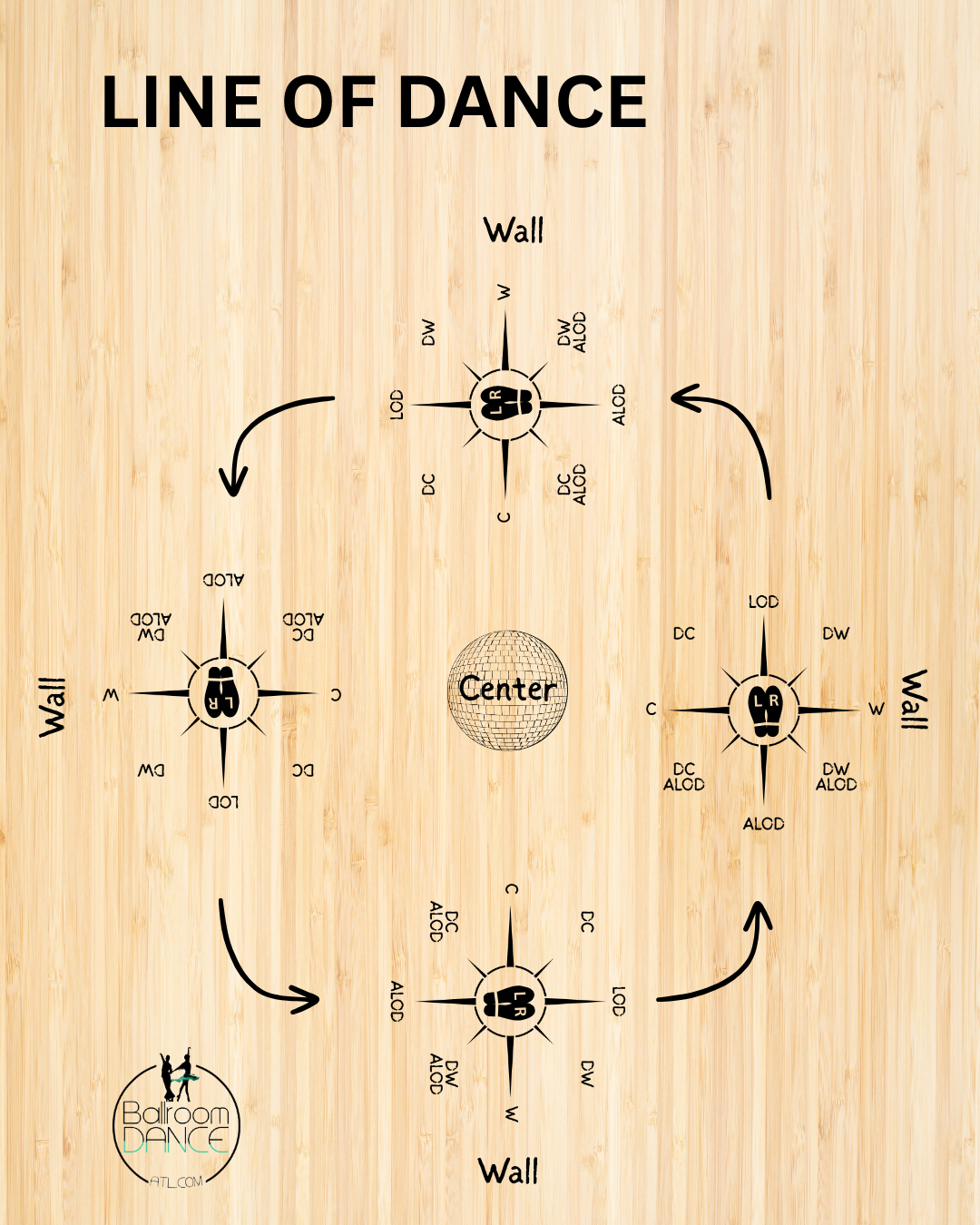
Key Room Alignments (Compass Analogy):
- Line of Dance (LOD) – Think of this as North. It’s the direction dancers travel around the perimeter of the dance floor, usually counterclockwise.
- Against Line of Dance (ALOD) – Like South. Directly opposite of LOD. Moving against the natural traffic flow.
- Wall (W) – Like East. Toward the outer edge of the room (or toward the audience in many performances).
- Center (C) – Like West. Toward the center of the dance floor (inward direction).
- Diagonal Wall (DW) – Like Northeast. Toward a spot between LOD and Wall.
- Diagonal Center (DC) – Like Northwest. Toward a spot between LOD and Center.
- Against Diagonal Wall (DW ALOD) – Like Southeast. Opposite of DW; diagonally back toward the Wall.
- Against Diagonal Center (DC ALOD) – Like Southwest. Opposite of DC; diagonally back toward the Center.
Understanding Qualifying Terms in Room Alignments
After learning the Key Room Alignments, it’s important to understand the qualifying terms that often accompany them. These words provide additional detail that helps dancers interpret how to orient their bodies or how a step is being executed in relation to a specific direction. You’ll hear these terms frequently in both group and private instruction, choreography breakdowns, and dance manuals.
Here are the most common qualifying terms associated with room alignments:
- Facing (F.) - This means the front of your body is pointed in the specified direction.
-
- Example: “Facing Diagonal Wall” means your torso is aligned with and looking toward Diagonal Wall.
-
- Backing (B.) - The opposite of facing—your back is toward the specified direction, and you are either stepping backward into it or exiting a figure with your back to that alignment.
-
- Example: “Backing Line of Dance” means your back is toward LOD as you move or finish a figure.
-
- Pointing (P.) - Used mostly in foot placements, “pointing” refers to the direction your foot is aimed, regardless of where your body is facing.
-
- Example: “Pointing Diagonal Center” could mean your foot is placed in that direction, even if your torso is rotated slightly differently.
-
- Moving Toward (M.) - Describes the direction your step travels—not necessarily where your body is facing. This is especially useful in steps involving body rotation or when traveling in one direction while facing another.
-
- Example: “Moving Toward Wall” means you are physically stepping in that direction, even if you’re not facing it directly.
-
- End Alignment (E.) - This term refers to where the body is oriented *after* completing a figure. It’s commonly used when describing the result of a turn or sequence of steps.
-
- Example: “Ends facing Diagonal Center” gives you a clear reference for where you should be positioned when a figure is completed.
-
These qualifiers bring clarity to choreography and help dancers analyze movement more deeply. Knowing not just where you are, but how you’re relating to that space, is the key to fluid, intentional ballroom dancing.
Why This Compass Approach Helps:
- It provides clarity and consistency when teaching or learning choreography.
- Dancers can orient their bodies and steps properly in any space.
- Instructors can give precise cues (e.g., “step DW” or “turn to face C”).
- It enhances spatial awareness, especially in partner dancing where alignment impacts lead and follow roles.
Using this mental compass helps dancers navigate the floor just as easily as a sailor would chart a course at sea. It’s all about direction, precision, and flow.
How to Use the Ballroom “Compass”
Once you understand the concept of room alignments, you can start using them like a compass to analyze movement with purpose and precision. Every step in ballroom dancing has a starting point and a destination—both of which can be defined using room alignment terms. By identifying where a figure begins and where it is supposed to end, along with how much rotation is involved, you create a landmark goal for your movement. This approach takes the guesswork out of dancing and replaces it with spatial intention.
Start, Rotate, Arrive
When approaching a new dance figure, ask yourself:
- What alignment am I starting from?
- How many steps does the figure take?
- How much turn or rotation is expected?
- Where should I end up—what is my destination alignment?
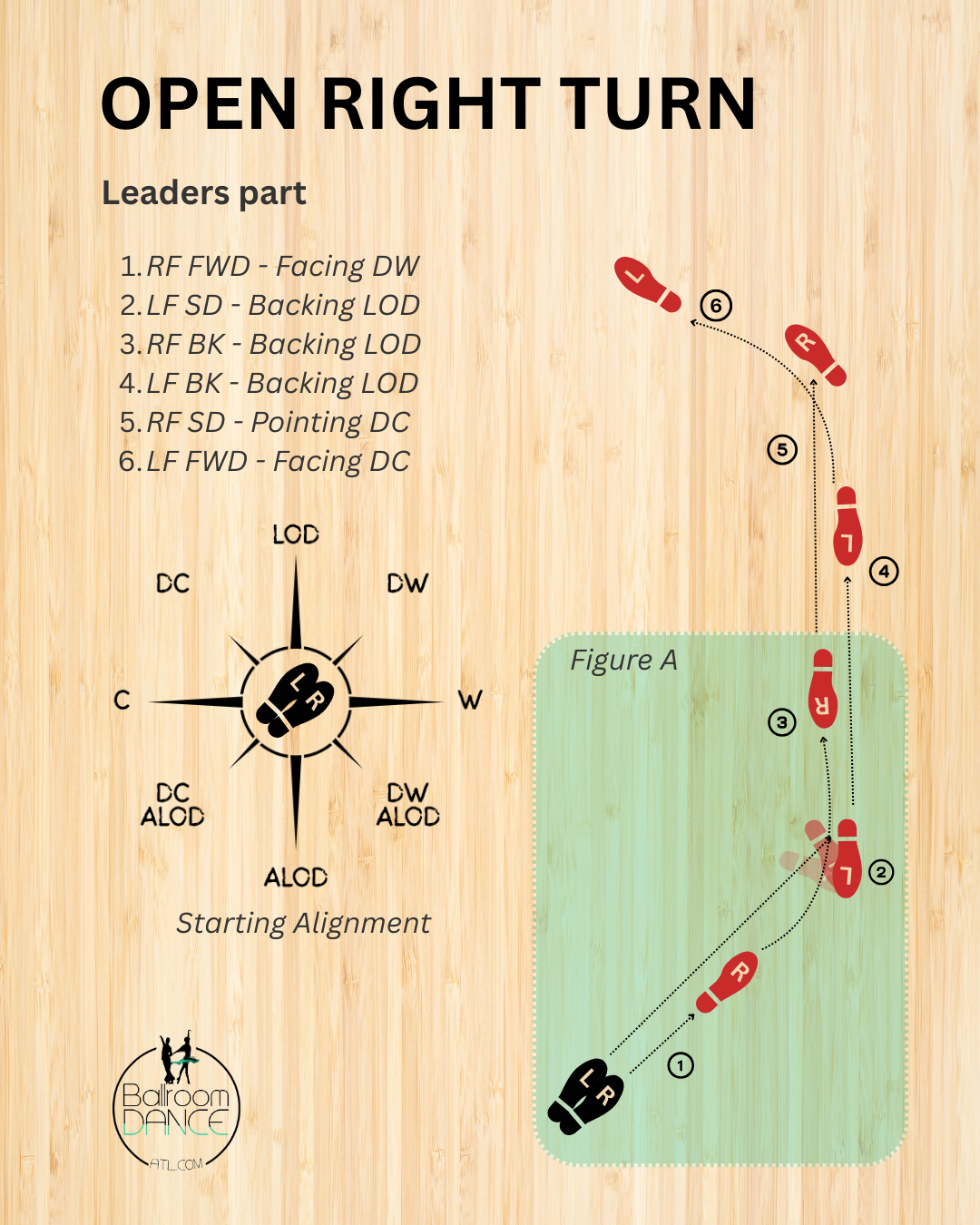
For example, you may start facing Diagonal Wall and need to end backing Line of Dance after a 3/8 turn to the Right. This directional path gives you a literal road map on the dance floor—guiding not just your feet, but your body position and lead/follow intentions. See Figure A
Left vs. Right Turns: A Useful Pattern
You’ll also notice a helpful trend:
- Most left turning figures tend to start facing Center or Diagonal Center
- Most right turning figures begin facing Wall or Diagonal Wall.
This pattern can be a powerful tool when reading the floor in real time. For instance, if you’re planning a left-turning figure and you see the space toward Center is blocked by another couple, it may be better to delay that movement or modify your path. Conversely, if you're aiming to turn right and see an open space toward Wall, you know you’ve got a natural lane for that figure.
Using the room alignment compass in this way turns your dancing into strategic movement—giving you confidence, clarity, and control. It enhances floorcraft, improves your ability to execute choreography, and helps keep the flow of traffic smooth and respectful to others sharing the space.
