Uncategorized

Room Alignments – Your Compass on the Dance Floor

Introduction to Room Alignments in Ballroom Dance

In ballroom dancing, precision and orientation are just as important as rhythm and technique. One essential concept that helps dancers navigate the floor with accuracy is room alignment. Room alignments refer to the standardized directions dancers use to position and move themselves within a ballroom. Much like a compass provides direction for navigation, room alignments offer a spatial framework that helps both instructors and students understand where steps should begin, end, or transition.

Whether you're learning your first box step or refining a competition routine, understanding room alignments is key to executing patterns correctly, maintaining flow on the dance floor, and communicating effectively with your partner. Let’s explore what these alignments are and why they’re a fundamental part of every ballroom dancer’s skill set.

In ballroom dancing, room alignments can be compared to points on a compass to help dancers understand direction and orientation within the ballroom. Just like a compass uses North, South, East, and West to indicate direction, ballroom dancing uses a set of standardized reference points in the room to define where movements begin and end. Here's how room alignments translate to compass-like directions:
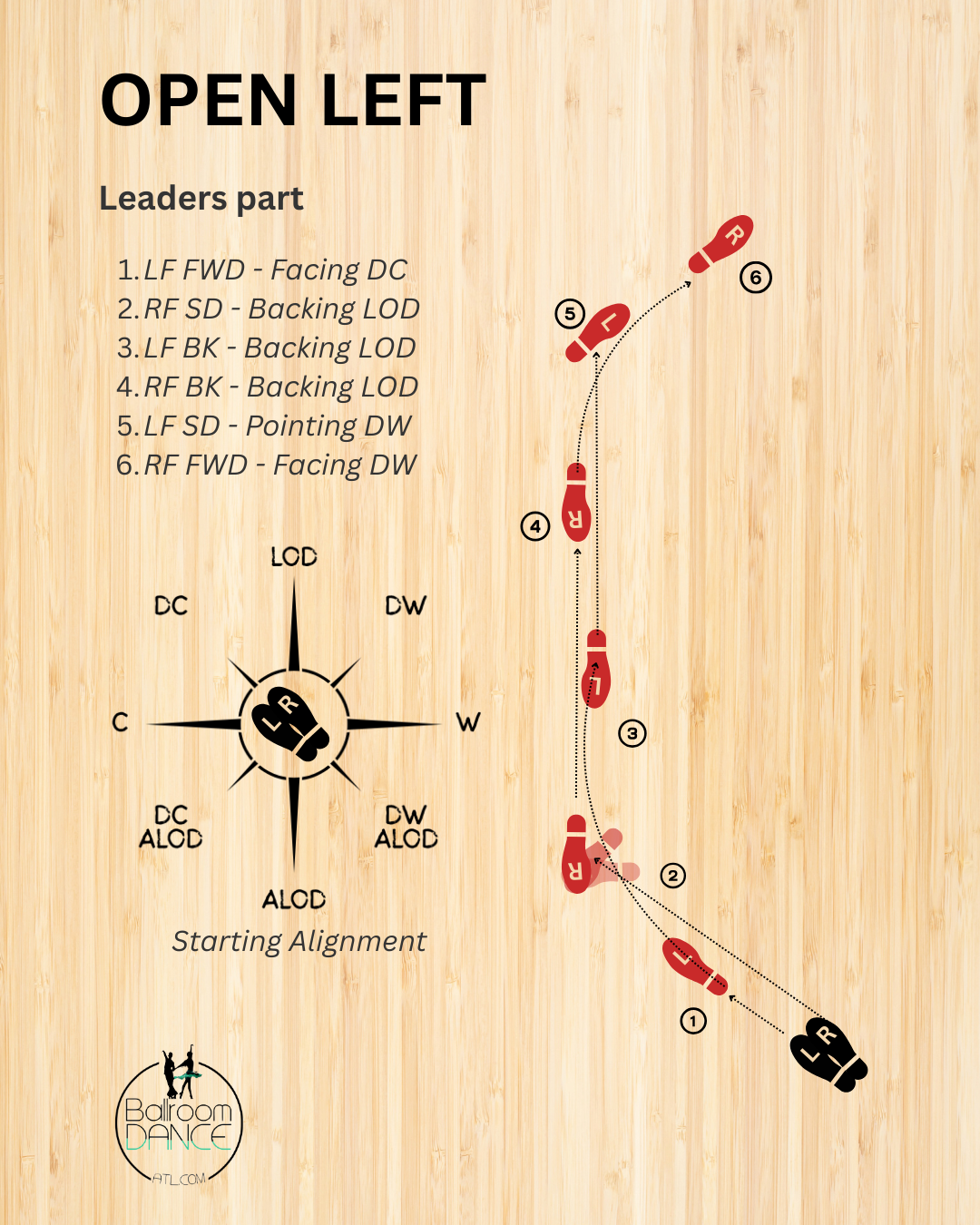
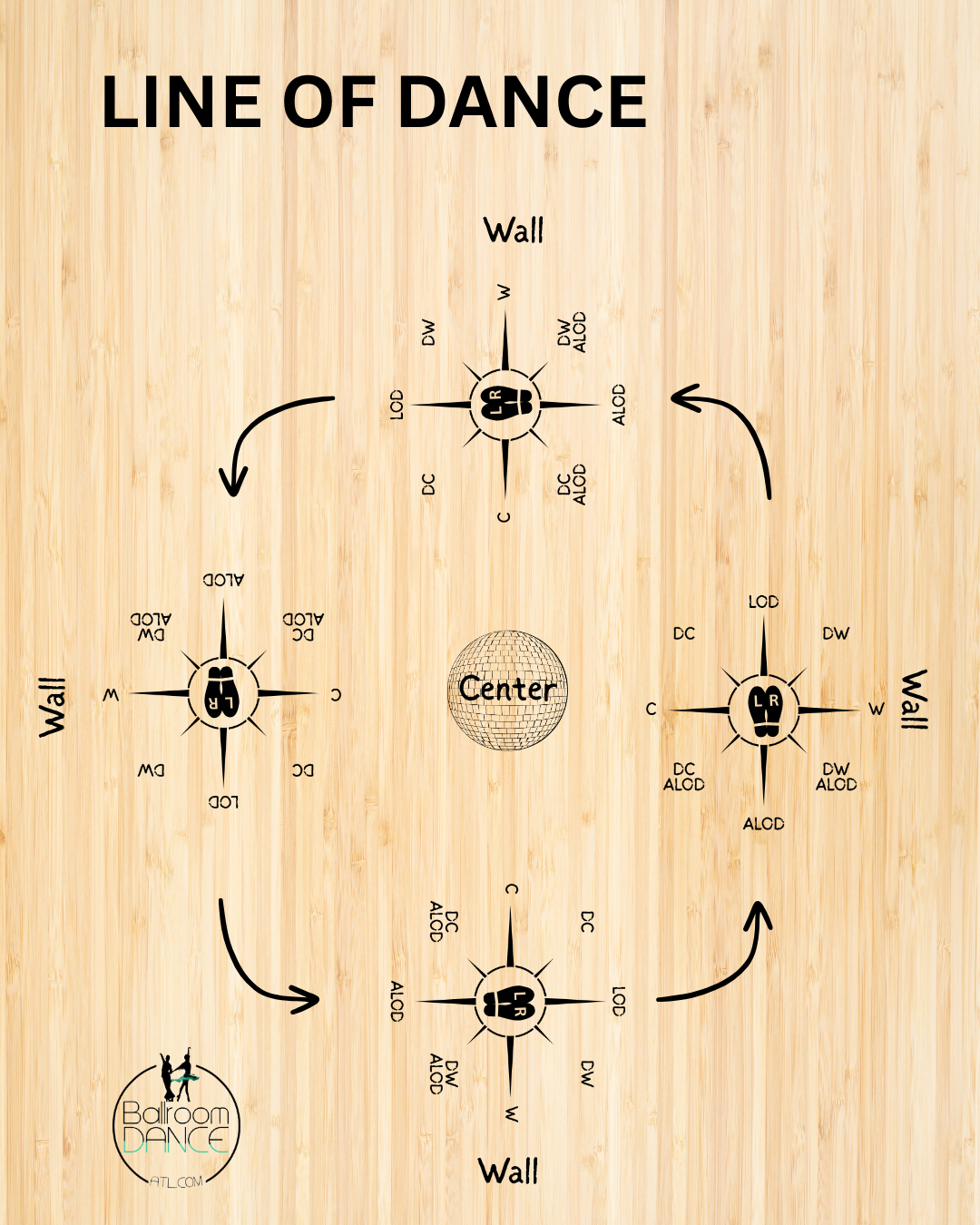
Key Room Alignments (Compass Analogy):

  • Line of Dance (LOD) – Think of this as North.  It’s the direction dancers travel around the perimeter of the dance floor, usually counterclockwise.
  • Against Line of Dance (ALOD) – Like South.  Directly opposite of LOD. Moving against the natural traffic flow.
  • Wall (W) – Like East.  Toward the outer edge of the room (or toward the audience in many performances).
  • Center (C) – Like West.  Toward the center of the dance floor (inward direction).
  • Diagonal Wall (DW) – Like Northeast.  Toward a spot between LOD and Wall.
  • Diagonal Center (DC) – Like Northwest.  Toward a spot between LOD and Center.
  • Against Diagonal Wall (DW ALOD) – Like Southeast.  Opposite of DW; diagonally back toward the Wall.
  • Against Diagonal Center (DC ALOD) – Like Southwest.  Opposite of DC; diagonally back toward the Center.

Understanding Qualifying Terms in Room Alignments

After learning the Key Room Alignments, it’s important to understand the qualifying terms that often accompany them. These words provide additional detail that helps dancers interpret how to orient their bodies or how a step is being executed in relation to a specific direction. You’ll hear these terms frequently in both group and private instruction, choreography breakdowns, and dance manuals.

Here are the most common qualifying terms associated with room alignments:

  • Facing (F.) - This means the front of your body is pointed in the specified direction.
      • Example: “Facing Diagonal Wall” means your torso is aligned with and looking toward Diagonal Wall.
  • Backing (B.) - The opposite of facing—your back is toward the specified direction, and you are either stepping backward into it or exiting a figure with your back to that alignment.
      • Example: “Backing Line of Dance” means your back is toward LOD as you move or finish a figure.
  • Pointing (P.) - Used mostly in foot placements, “pointing” refers to the direction your foot is aimed, regardless of where your body is facing.
      • Example: “Pointing Diagonal Center” could mean your foot is placed in that direction, even if your torso is rotated slightly differently.
  • Moving Toward (M.) - Describes the direction your step travels—not necessarily where your body is facing. This is especially useful in steps involving body rotation or when traveling in one direction while facing another.
      • Example: “Moving Toward Wall” means you are physically stepping in that direction, even if you’re not facing it directly.
  • End Alignment (E.) - This term refers to where the body is oriented *after* completing a figure. It’s commonly used when describing the result of a turn or sequence of steps.
      • Example: “Ends facing Diagonal Center” gives you a clear reference for where you should be positioned when a figure is completed.

These qualifiers bring clarity to choreography and help dancers analyze movement more deeply. Knowing not just where you are, but how you’re relating to that space, is the key to fluid, intentional ballroom dancing.

Why This Compass Approach Helps:

  • It provides clarity and consistency when teaching or learning choreography.
  • Dancers can orient their bodies and steps properly in any space.
  • Instructors can give precise cues (e.g., “step DW” or “turn to face C”).
  • It enhances spatial awareness, especially in partner dancing where alignment impacts lead and follow roles.

Using this mental compass helps dancers navigate the floor just as easily as a sailor would chart a course at sea. It’s all about direction, precision, and flow.

How to Use the Ballroom “Compass”

Once you understand the concept of room alignments, you can start using them like a compass to analyze movement with purpose and precision. Every step in ballroom dancing has a starting point and a destination—both of which can be defined using room alignment terms. By identifying where a figure begins and where it is supposed to end, along with how much rotation is involved, you create a landmark goal for your movement. This approach takes the guesswork out of dancing and replaces it with spatial intention.

Start, Rotate, Arrive

When approaching a new dance figure, ask yourself:

  • What alignment am I starting from?
  • How many steps does the figure take?
  • How much turn or rotation is expected?
  • Where should I end up—what is my destination alignment?

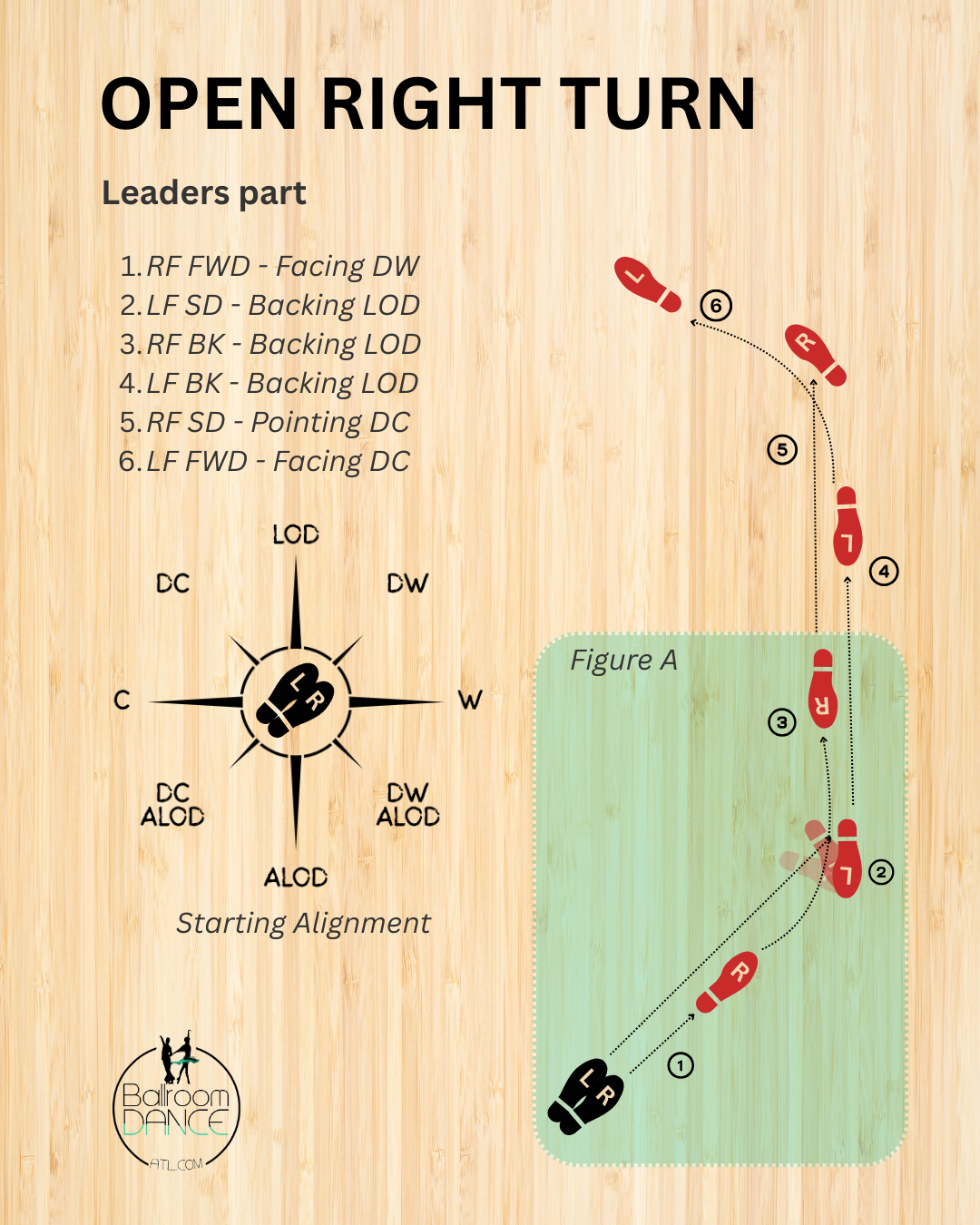
For example, you may start facing Diagonal Wall and need to end backing Line of Dance after a 3/8 turn to the Right. This directional path gives you a literal road map on the dance floor—guiding not just your feet, but your body position and lead/follow intentions. See Figure A
Left vs. Right Turns: A Useful Pattern

You’ll also notice a helpful trend:

  • Most left turning figures tend to start facing Center or Diagonal Center
  • Most right turning figures begin facing Wall or Diagonal Wall.

This pattern can be a powerful tool when reading the floor in real time. For instance, if you’re planning a left-turning figure and you see the space toward Center is blocked by another couple, it may be better to delay that movement or modify your path. Conversely, if you're aiming to turn right and see an open space toward Wall, you know you’ve got a natural lane for that figure.

Using the room alignment compass in this way turns your dancing into strategic movement—giving you confidence, clarity, and control. It enhances floorcraft, improves your ability to execute choreography, and helps keep the flow of traffic smooth and respectful to others sharing the space.

Download a PDF

The Secret to Ballroom Bliss: Why Leading and Following Can Wait

As a seasoned ballroom dance instructor, I’ve seen it all. One of the most frequent (and endearing) questions I get is about leading and following. It’s a vital part of partnership dancing, but it’s often the first thing students want to conquer. Imagine trying to run before you can walk – that’s pretty much what’s happening here.

Think back to your first time playing catch. Did you immediately know how to snag that ball flying your way? Probably not. First, you learned to catch when you saw it coming. Only after lots of practice did you start catching balls on instinct, even if they came out of nowhere. This same principle applies to dancing: foundation first, fancy stuff later.

When I introduce a new move, my role is to lead, guiding you through the steps. Yet, almost immediately, hands shoot up with questions about leading and following. “Hold your horses!” I think. “Let’s nail the steps before we worry about who’s doing the leading.”

Here’s a fun analogy: imagine baking a cake but worrying about the frosting before the batter is even mixed. You wouldn’t do that, right? In dance, the steps are your batter. Get them right, and the leading and following – your frosting – will come naturally and make everything sweeter.

Now, for a bit of humor. Picture this: You’re learning to dance, and suddenly you’re more focused on leading like Fred Astaire or following like Ginger Rogers than simply getting the steps right. Spoiler alert: even Fred and Ginger had to learn their basic steps first!

So here’s my tip: relax, enjoy the process, and focus on mastering the moves. Once you can dance the steps without overthinking, leading and following will fall into place effortlessly. Trust me, your dance partner will thank you.

One more tip from the vault of dance wisdom: practice makes perfect. Whether it’s a quickstep or a slow waltz, repetition is your friend. The more you practice, the more natural the moves become, and soon enough, you’ll find yourself leading and following like a pro without even realizing it.

Remember, dancing is supposed to be fun! Laugh at your missteps, celebrate your progress, and let the music move you. After all, it’s not just about the destination but the joy of the journey. So, dance first, lead later, and watch your ballroom bliss unfold.

Happy dancing!

To Rotate or Not to Rotate: A Dance Floor Dilemma

To Rotate or Not to Rotate: A Dance Floor Dilemma

As an experienced social ballroom dance instructor, I have witnessed many couples navigate the intricate steps of learning to dance together. However, one experience stands out, shedding light on a common classroom challenge—the decision to rotate partners or not. Let me share the story of a couple who chose to dance exclusively with each other during class, a decision that profoundly impacted their learning and enjoyment.

The Story of a Struggling Couple

In one of my classes, there was a couple determined to stick together, believing it would better prepare them for their future as dance partners. Initially, they were enthusiastic, but as the class progressed, their decision seemed to hinder their growth. Unlike their classmates who rotated partners and experienced a variety of styles and feedback, this couple struggled with the same issues repeatedly.

Their inability to adjust to different dancing approaches led to frequent missteps and growing frustration. As the complexity of the dances increased, they found themselves needing more attention from me, often to the detriment of other students. This couple, unfortunately, began to monopolize my time, asking for repeated demonstrations and one-on-one guidance, disrupting the class flow.

As the weeks passed, their frustration with each other escalated. They disagreed openly about techniques and timing, each blaming the other for their struggles. Their once joyful learning experience turned into a series of arguments and resentment. Ultimately, they left the class angry and disheartened, a stark contrast to their fellow dancers who benefited from partner rotation and shared many laughs and successes.

Why Rotating Partners is Crucial

This example underscores several key benefits of rotating partners in a dance class:

1. Enhances Learning and Adaptability: Dancing with different partners exposes students to various styles and techniques, accelerating the learning process and helping dancers become adaptable.

2. Improves Leading and Following Skills: Rotation allows dancers to experience leading and following with different partners, sharpening their communication and responsiveness on the dance floor.

3. Encourages Social Interaction and Builds Community: Rotating partners fosters a friendly atmosphere, where all students interact and support each other, enhancing the social experience of the dance class.

4. Reduces Pressure and Anxiety: Rotating relieves the pressure of constant scrutiny from a single partner and spreads interactions across the class, creating a more relaxed and enjoyable environment.

Conclusion

The story of this couple illustrates a critical lesson: while dancing with a familiar partner may seem comforting, it often limits growth and can lead to frustration. Encouraging partner rotation not only builds technical skills but also enhances the overall classroom dynamics, making learning more comprehensive, enjoyable, and socially enriching. As an instructor, I advocate for rotation, ensuring that all students leave the class not just as better dancers, but as individuals who truly enjoy every step of their dance journey.

Who’s Leading Anyway – Life’s lessons on the dance floor

Who's Leading Anyway is a title of a chapter in a friend's (hopefully) soon to be written book. I'd like to borrow it to talk about my experience as a dance instructor. Leading and following is topic that has spurred a lot of conversation about the roles we play in relationships on and off the dance floor. And this will probably be discussed a lot on this blog. But today, the focus is on the 3rd partner of partnership dancing. The true leader. The Music. In dance, it's the music that is the true leader.  It gives us the dance, the tempo, the mood.  It tells a story. It revs us up and settles us down.   Dance is that physical representation of what music does to us. And when it's done well, it's beautiful.  As an instructor, I teach people to align their movement to the music, helping them create beauty on the dance floor. Now, how does this parallel life?  In life, do I align myself to the 'music' of my life? Do I let something, someone take the Lead? For most of my life, no – I danced to the beat of my own drum, following my own impulses and desires. (Yes, I am the middle child.) But, now, is my life beautiful?.... No. Now, don't get me wrong. I love my life and the people in it. But, I see the struggle against the flow of life. Just as I sometimes see a dancer who's not quite with the music and he/she doesn't want to get with the music. It's almost as if there is a struggle for which creative force will take center stage. The music vs the dancer, not a harmonious combination of both. Of late, I've really been growing in my understanding of what faith truly is, what letting go really is and what it means to have God guide my life. And as I look back at the instances in my life where I have unwittingly 'danced' my life well, I do see the beauty. I do see the harmony. I also still see me in the performance. Which is what I think I was most fearful about in letting go. Getting lost in performance. Not living MY life. This is not the case. There is beauty in aligning my life to God's will, and there is personal freedom within that will. What's funny is that when I teach women to follow, I assure them that there is room for personal expression within the lead. And that they have choices that doesn't disrupt the lead. I guess I needed some assurance too. Going forward, I am going to pay more attention to the music of life. And express within it. (I suspect in time that I'll look back at the dance of my life and see the beauty in the struggle too... not there yet)  ---- David, please finish the book, I look forward to reading it.

hello

Welcome to my site.

And if you are new to ballroom dancing, I look forward to introducing you to this fun and exciting activity.  Ballroom dancing is one of those activities that you can participate as much or as little as you desire; if you are looking to compete in this dancesport or if you just want have some fun at the next dance social.  Whatever your goal, please allow me to help you.  This site has some info on how I can help.  If you have any questions please contact me.

See you out on the dance floor!!!